Just Bought in France? 5 Garden Rules That Can Cost You Money
By Laurent, landscaper for 32 years, Dordogne · 28 October 2026
You bought a house in France. Lovely. The garden came with it, and so did a set of rules that nobody mentioned at the notaire's. Most owners find out the hard way: a neighbour at the gate, a letter from the mairie, an insurer asking questions. I have worked on gardens in the Dordogne for 32 years. These are the five rules that trip people up, and what to ask before you act.
First, a thing nobody tells you
Much of this is not national law. The state sets a frame, then your département and your commune fill in the blanks: hours, dates, zones. Two villages ten kilometres apart can have different orders. So the one habit I would give any new owner is this: before you buy a hedge trimmer, light a fire or plant a row of laurels, call or visit the mairie. Whatever they tell you is the answer that counts. And it's free.
1. Clear the brush around your house (débroussaillement)
If your house is in or near woodland, roughly within 200 m of a wood or forest, the owner has to keep the vegetation around it under control. It's called débroussaillement, and it surprises foreigners most because it is a duty, not advice. In the Dordogne the usual figures are 50 m around buildings, plus a strip along your private access road: the préfecture quotes 4 m each side.
Nobody is asking you to turn the land into a golf course. The point is to break the chain of fuel. Cut the grass and brambles before the dry season. Take out dead wood and dead shrubs. Thin the trees so the crowns don't touch, and take the lower branches off the ones you keep. Branches over the roof or near the chimney go too.
If the 50 m runs onto your neighbour's land, it is still your job, and they are generally obliged to let you in. Talk to them early. If you do nothing, the mairie can do the work and send you the bill, and you can be fined. There is another side to it: if a fire reaches a house that was never cleared, the insurer will have a few hard questions. To know whether your plot is concerned, ask the mairie for the local order and the zone map, or look up obligations légales de débroussaillement on the préfecture's site.
My own rule: do the first big clearing in autumn or late winter, when there is no fire risk and the ground is soft. Then a quick mow and trim in late spring. Two light passes beat one monster job every time.
2. Do not burn your garden waste
A bonfire of prunings is a normal autumn weekend in plenty of countries. In France, burning green waste in the open air is banned for households, and the fine can reach 450 euros. Yes, you will see neighbours doing it. That doesn't make it legal, and a neighbour who is tired of the smoke can report you.
So what do you do with it all? Take it to the déchetterie, the waste centre. It's usually free for residents, but ask the mairie whether you need an access card and whether second-home owners are covered. Or shred it and spread it as mulch: on a big garden a shredder pays for itself fast. Soft material goes in the compost. Leaves make the best free mulch you'll ever get.
One nuance. Some burning linked to brush clearing is allowed in certain places and at certain times, under conditions set by the préfecture. That's an exception, so don't take a forum's word for it. Ask first.
3. Respect the distance to your neighbour
Article 671 of the Civil Code sets the minimum distance between a plantation and the boundary: 50 cm for plants that stay under 2 m, 2 m for anything taller. You measure from the middle of the trunk or stem to the boundary line. If a hedge is too close or too tall, the neighbour can ask you to cut it back or take it out. Don't bet on them staying quiet.
Then there's article 673. If your branches overhang their land, they can require you to cut them, and the same goes for roots. It works the other way round too.
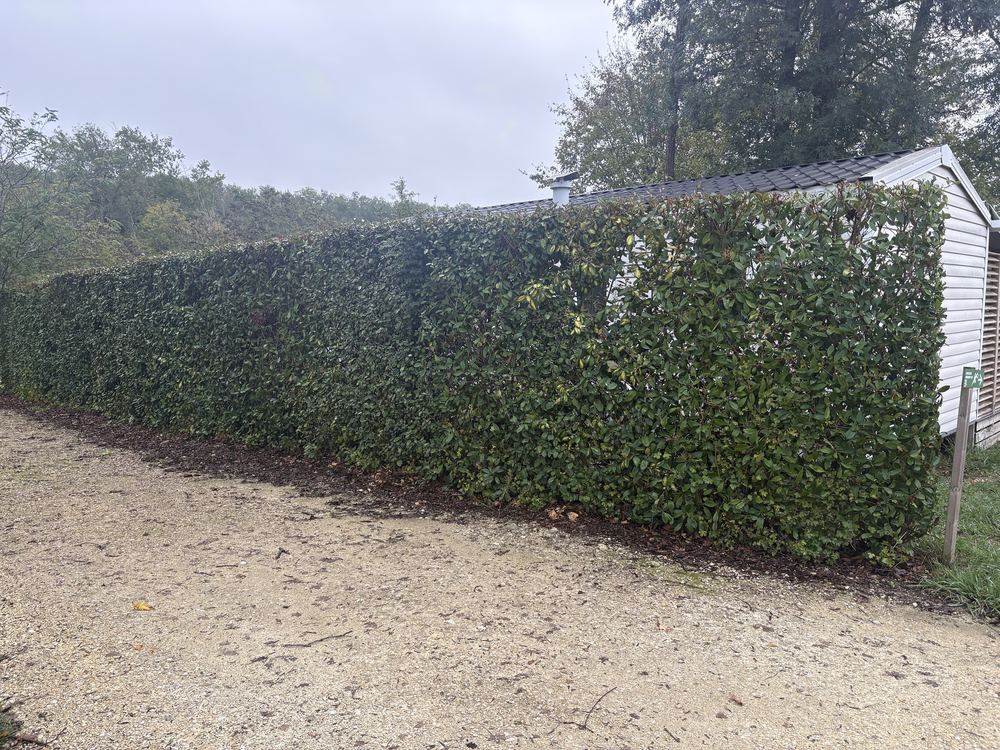
When I plant a long hedge I stay well back from the minimum. A laurel or a photinia will happily reach 3 m, and a hedge 50 cm from the line means your neighbour's side can only be trimmed from a ladder. Check the local urban plan (the PLU) too, because some communes set their own limits. In a housing estate, the règlement de lotissement can add more.
4. Mind your mowing hours
There is no national timetable for mowers, hedge trimmers, chainsaws, leaf blowers or brush cutters. The préfecture sets rules, the mairie often adds its own, and the pattern is much the same everywhere: weekday daytime, shorter on Saturday, a short window on Sunday morning, nothing at lunch. Just to show the shape, a typical order runs from about 8:30 to 12:00 and 14:30 to 19:30 on weekdays, a bit less on Saturday, and roughly 10:00 to 12:00 on Sundays and public holidays. Those are not your commune's hours.
Lunch is a serious institution here. A mower at 12:45 on a Sunday is the quickest way to meet the neighbours for the wrong reasons. The notice at the town hall, usually on the commune's website as well, is the one that counts. If you need the words: « Quels sont les horaires autorisés pour utiliser une tondeuse ou un taille-haie ? »
5. Leave the birds alone in nesting season
For a private owner there is no fixed legal date that bans hedge cutting. Farmers have dated rules under the farm policy, but a homeowner doesn't. What is forbidden is destroying the nests of protected birds, and a hedge cut in the middle of spring does exactly that. Bird protection groups say leave hedges alone from about 15 March to 31 July, and some push it to mid-August. See a nest? Wait.
For the hedge itself, September and October is the sweet spot for routine trimming: the birds are done, and the hedge stays tidy all winter. If it has gone woody and needs a hard cut, do it in late winter, February or early March, before the sap rises and before nesting starts. Stay off it in the heat of July and August, because newly exposed leaves burn in the sun. And with conifers, never cut back into old wood with no leaves on it. It will not grow back.
Your first month: a short checklist
- Ask the mairie whether your plot is in a brush-clearing zone, and for the local noise order.
- Find out where the nearest déchetterie is, its opening hours, and whether you need an access card.
- Walk the boundary and measure the distance of any hedge or tree to the line.
- Note which of your trees overhang the neighbour's land, and the other way round.
- Look for nests before any hedge work between spring and the end of summer.
- Get a shredder, or find someone who has one, instead of planning a bonfire.
I cannot know your exact commune, so use this as a checklist of what to ask your mairie, not as the last word. Rules change, and local orders differ.
Read more (in French)
Most of my articles are in French for now, and your browser can translate them in one click. These go with the rules above:
- Débroussaillement obligatoire en Dordogne
- Brûler ses déchets verts : que faire à la place
- Quand tailler sa haie ?
- Quelle haie planter
Sources: article 671 and article 673 of the Code civil (planting distances, overhanging branches); Code forestier and prefectural guidance for the Dordogne (brush clearing); the ban on open-air burning of green waste; municipal and prefectural noise orders; bird protection guidance on the nesting season. General information, not legal advice.
Frequently asked questions
Is it illegal to burn garden waste in France?
In principle yes. Burning green waste in the open air is banned for households, and the fine can reach 450 euros. Take it to the local waste centre (déchetterie) or shred it for mulch.
What is débroussaillement and does it apply to me?
It is the legal duty to clear brush and undergrowth around buildings in or near woodland. The usual rule is 50 m around the house, plus a strip along private access roads. Your mairie or the préfecture can tell you whether your plot is in a zone concerned.
Who has to do the brush clearing and who pays?
The owner of the house, even if part of the 50 m lies on a neighbour's land. If you do nothing, the mairie can have the work done at your expense and you may be fined.
How close to my neighbour can I plant a hedge?
Under article 671 of the Civil Code: at least 50 cm from the boundary for plants up to 2 m high, and at least 2 m for anything taller, measured from the middle of the trunk. Local customs and the local urban plan can change this.
My tree overhangs my neighbour's garden. What are my duties?
Under article 673 of the Civil Code, a neighbour can require you to cut branches that overhang their land. The same applies to roots.
When can I use a lawn mower or hedge trimmer in France?
There is no single national schedule. Hours are set by prefectural and municipal orders, and they usually allow weekday daytime, shorter hours on Saturday, a short window on Sunday morning and nothing at lunchtime. Ask your mairie.
Can I cut my hedge in spring?
There is no fixed legal date for private owners, but destroying nests of protected birds is forbidden. Bird protection groups advise leaving hedges alone from about 15 March to 31 July, and some say until mid-August.